Fossil gas vs biogas: which one is actually more expensive?
We often hear it said thatbiomethane is too expensive to produceand that it is not profitable for businesses. But is this really true? Let’s analyse the current energy market.
Natural gas: an energy source with volatile prices
Fossil natural gas remains the go-to energy source for millions of households and businesses in France. However, its price is highly volatile.
Europe’sheavyreliance on gas importsplaces a significant strain on budgets. During geopolitical crises, such as the war in Ukraine which began in February 2022, the European benchmark price rose froman average of €47/MWh in 2021 to €132/MWh in 2022, peaking at€311/MWh in August.(Source)
Since then, prices have never really come down again. In February 2026, the price permegawatt-hourof gas stoodat €99.82for a gas-heated household,compared witharound€51.30at the start of 2021 –a rise of 95 per cent. It would appear that the energy crisis has become a permanent feature in France.(Source)
The situation in May 2026 perfectly illustrates the fragility of the current energy market. On 1 May 2026, the price of natural gas rose by a further 15.4 per centon average, reaching €160.54/MWh due to geopolitical tensions in the Middle East(Source)
Is biogas really more expensive?
Biomethaneis a gas produced by the anaerobicdigestion of organic waste, a natural process in which organic matter is broken down by bacteria known as anaerobes. At present, its production cost remains higher than that offossilgas, with anaverage price of €102/MWhcompared with €32/MWh for natural gas. (Source)
However, this cost is not passed on entirely to the consumer. The government funds a large part of this differencethrough so-called‘Feed-in Tariff’contracts. This scheme guarantees biomethane producers a tariff high enough to make their facilities profitable by making up the difference between this and the market price.
TheseFeed-in Tariffcontractsalso reflect the sector’s positive trajectory. The 2020 decree introduced an initial reduction in tariffs ranging from€86 to €122 per MWh, depending on the size of the plant. Then the 2023 decree marked a second significant reduction, bringing thetariffs for new contracts down to between €24 and €32/MWh.
Older contracts, signed when the technology was less mature, had much higher tariffs. Asthese contracts run for 15 to 20 years, they still push up the overall average. This explains why the overall feed-in tariff for biogas still stood at €102/MWh in July 2024; not because biogas is still so expensive to produce, but because these older commitments still weigh heavily on the figures.
In future, feed-in tariffs will continue to fall as the sector matures. The median scenario projects astabilisation ataround €20–30/MWh by 2030,reaching parity with natural gas outside of crisis periods(Source)
Biomethane: a locally produced energy source
Unlike fossil gas, which is extracted from foreign subsoils, the raw materials for biogas areavailable throughout our country.
Thetheoretical potential of primary resources for anaerobic digestion – comprising agricultural materials, bio-waste and seaweed residues – has been estimated at140 TWh of primary energy production from biogas.(Source)
France ranks among the countries with the largest anaerobic digestion resources in Europe. National ambitions are commensurate with this potential. By 2024,France will produce 12 TWh of biomethane for injection into the grid. The targets set out in the national energy plan are44 TWh by 2030and150 TWh by 2050,equivalent to the country’s current gas consumption.(Source)
The raw material is available; it is local, renewable and does not depend on any decisions made by a foreign government.
The environmental benefits that tip the balance
Thecarbon content of biomethane is around 10 times lowerthan that of fossil natural gas. Source
According to ADEME,1 kWh of biomethane injected into thegasnetworkprevents the emission of 200 g of CO₂ equivalent.Source
Biogas is still generally more expensive today, but this gap is narrowing every year. Above all, comparing prices alone ignores the hidden costs of fossil gas: dependency, volatility and climate impact.
Producing your own biogas to break free from the market
It is possible to obtainbiogas at a competitive price. The key?Producing your own biomethane by processing your own bio-waste locally.
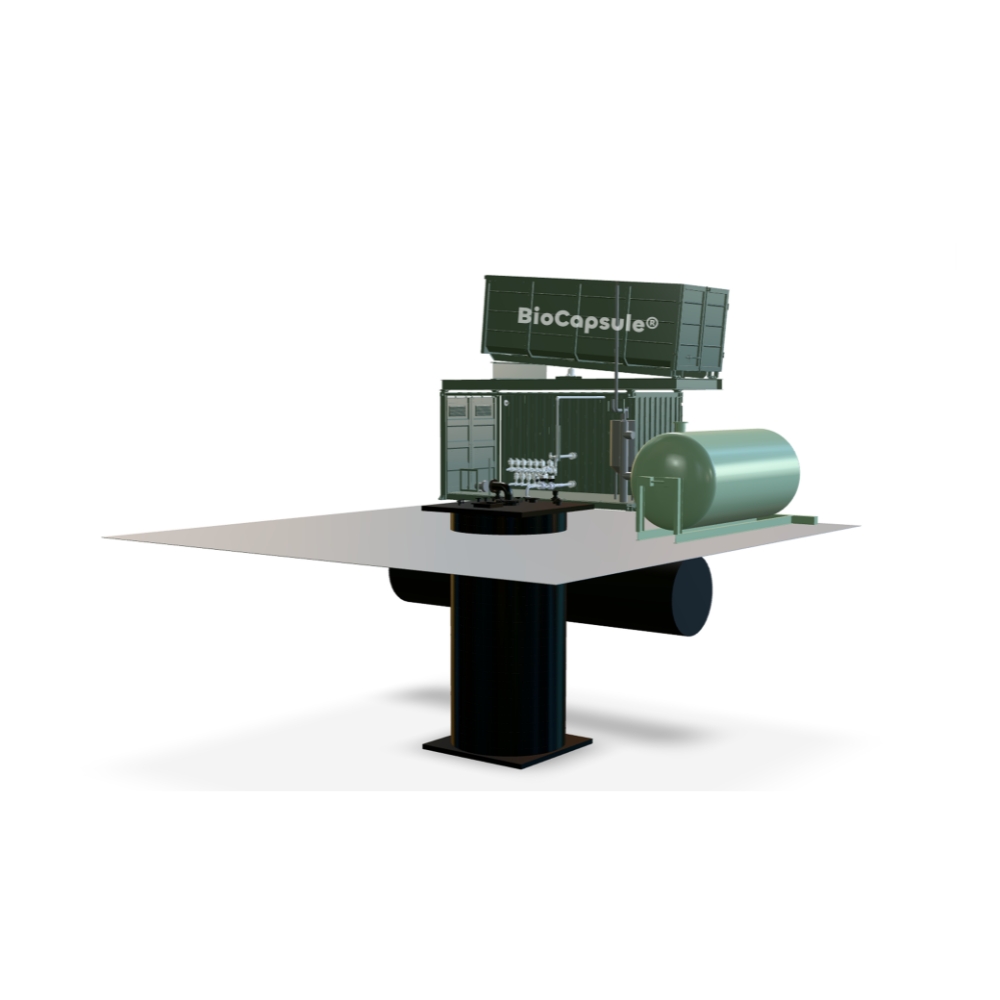
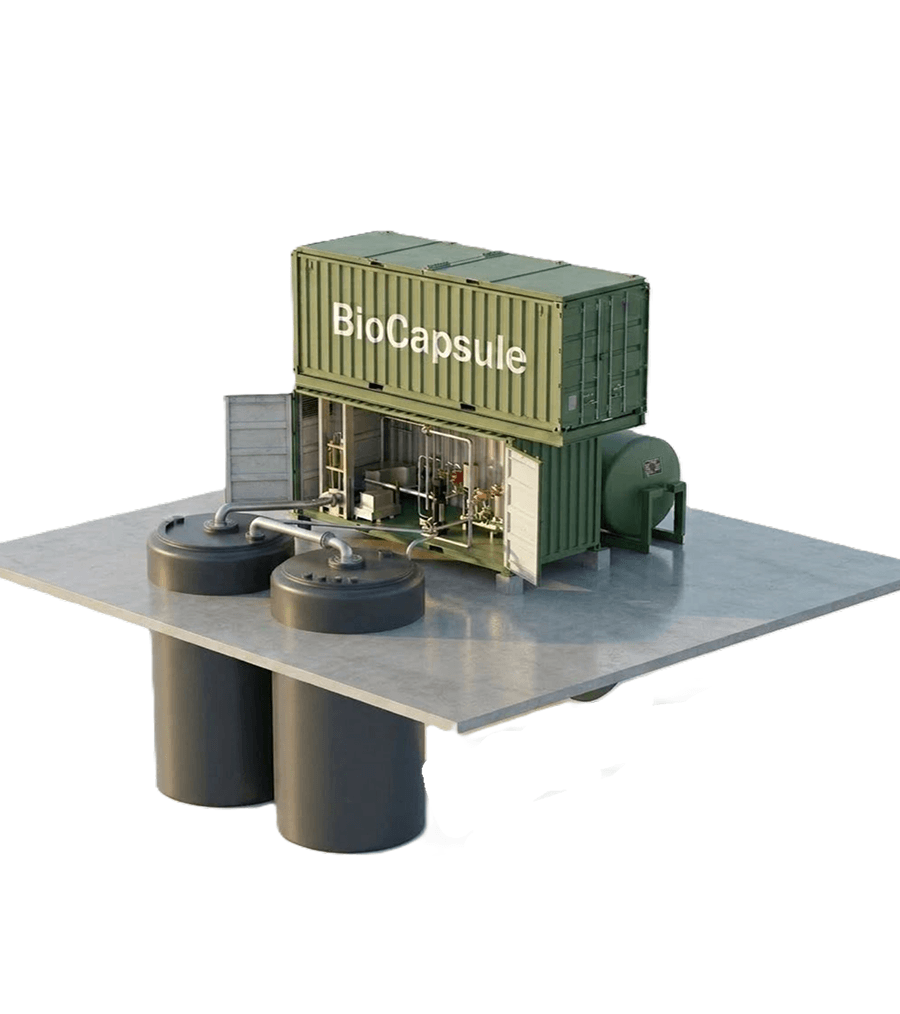
Arkeale’sBioCapsule®does precisely that. Thismicro-anaerobic digestion unit, one of the most compact on the market with a footprint ofjust 60 m², is designed for installation in urban areas, right next to the building it supplies with energy. The unit is capable of processingbetween 200 and 800 tonnes of bio-waste per yearto generate up to500 MWh of energy annually, which can be used in the formof gas, heat or electricity.
The BioCapsule® ensures arapid return on investment – around six years – by enabling its customers to make savings on their energy bills and on the costs of collecting and treating bio-waste. In practical terms, our first client has already achieved40 per cent energy self-sufficiency for its operations.